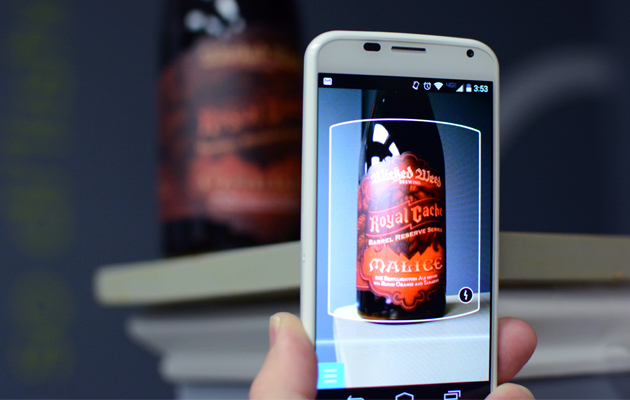
This blog has had many different articles or posts covering a wide range of interesting technology related posts, and a good number of those have been related to what the smartphone is becoming or what it can do for users. So to further that line of thought, I read up on a new app available to users on their smartphones called Next Glass!
This crazy new app is a wine chooser (it also does beer!) that can predict your preferred choice in beverages accurately using chemistry. Read up on it here for the full article, but essentially once the app gets to know your tastes through a questionnaire, you can scan the label of any wine or beer and it will give you a percentage rating on if you would like it or not. Smartphones are amazing devices that have an amazingly wide array of uses, which now also includes wine tasting!
This blog was created to share various interesting articles and information to anyone interested!
Thursday, November 20, 2014
Thursday, November 13, 2014
Thought Controlled Implants
There have been recent strides in prototype technologies that are aimed at the medical industry, where a user or a patient would be able to administer medications, or proteins straight into the brain from a small implant that would be potentially thought controlled. How amazing would it be to feel some aspect of illness coming on, and then just thinking about it makes it go away? That could be possible with so many diseases or even the common headache could be defeated with just a though. The technology works in test runs and has some really cool principles behind it. Check out the report at the Nature Communications website, or a much easier to read article on the report at Gizmag. Essentially when a signal is sent to this implant, either by thought or by a mental state that is subconscious, it creates a protein that then can diffuse into the brain and be easily detected in the body. Potentially you could have a medication released right onto the site of chronic pain or blockers onto an area that is causing a seizure with just a simple thought that would activate this implant, which would signal to the body or another implant to do something.
Friday, November 7, 2014
New Smartphone Uses in the Hospitality Industry
Smart phones are multipurpose devices that entered the consumer space years and years ago. Almost everyone owns one, or knows someone who does. But recently there has been a big push towards having smart phones enter the small business space, with tons of software and even external devices that have been developed to allow this device to expand its roles as a phone or a mobile browser. Essentially the phone is a powerful computer with a ton of features like GPS and a data package that can allow communication with the Internet.
A small business or even potentially a consumer can use devices such as the Square to take credit card payments right from their device, or use accounting or administration software from their phone to keep up to date on their life or investments; and as a huge plus the cost of the smart phone/device is small when compared to the uses it can do, making it a cost effective method for businesses to accomplish a wide variety of tasks.
Smart phones have also been able to unlock your car or your house remotely for years now, but a totally new adaptation for this technology has been with hotels, where they would allow guests to book a room, check in, and then open the door to their booked room all with their smart phone. Check out this video to get look at this awesome idea! Potentially a guest wouldn't ever even need to speak with another person, totally automating the process of getting a hotel room.
A small business or even potentially a consumer can use devices such as the Square to take credit card payments right from their device, or use accounting or administration software from their phone to keep up to date on their life or investments; and as a huge plus the cost of the smart phone/device is small when compared to the uses it can do, making it a cost effective method for businesses to accomplish a wide variety of tasks.
Smart phones have also been able to unlock your car or your house remotely for years now, but a totally new adaptation for this technology has been with hotels, where they would allow guests to book a room, check in, and then open the door to their booked room all with their smart phone. Check out this video to get look at this awesome idea! Potentially a guest wouldn't ever even need to speak with another person, totally automating the process of getting a hotel room.
Friday, October 24, 2014
The technology behind Sensing
Cars have been driven by people for decades, in every type of situation from the beach to the moon. But up until recently cars have just been purely operated by a sole user. Only recently have the technology advancements in the modern era allowed people to have assisted driving or even computer controlled cars. I saw the other day someone in my family buy one of these cars and the sophistication and elaborate computer systems in the car shocked me. If you take a look here, we can even see that Honda has developed their own version of a technology called Sensing that will brake the car for you if you are about to hit anything in front of you, and this isn't a new thing. It uses radar as well as cameras to detect objects in front of you. And this was only developed because of the competing brands that each have their own version of the same thing, but in every version the amount of smart technology that is included in your car grows, with more features being added you are safer, more reliable, and more efficient than ever in your car out on the road. Most people never even realize that there are so many computers in just about everything you do, making our lives easier or safer.
Friday, October 17, 2014
What starting your own business means
Have you every heard about a woman named Elizabeth Holmes? What if you knew that she was a dropout from school and never finished her education? Would anyone think that she would be America's first female billionaire by the age of 30? Elizabeth Holmes revolutionized the healthcare system by starting a company at the age of 19 that invented a cheap, reliable, and fast way for medical offices or other personnel to do a full range of blood tests without the need for a ton of blood. Her vision has lead her to not finish her degree but yet she still managed to fulfill the dream of most every American setting out on their own to start a small business. She made money, and helped millions of people while doing it. CNN had an article on her and her company, along with a neat little instructional video here. The small businesses of our country have an absolutely massive role on our economy, and in this case our healthcare system, so they are best not to be ignored. There can be a future for any small business with the right idea and the right resources, just like Holmes had.
Thursday, October 9, 2014
Security tips for small businesses
There are many companies and corporations and businesses around the world that have been the target of hackers or subject to data breaches in their million dollar systems. But something that many people do not realize is that small businesses are also very good targets for people looking to steal information. Most small businesses don't have the know how, or the ability to hire full time employees who can manage an IT system, and they can potentially be very unsecured. Many places just relying on the kindness of the thief to heed the "Do not connect here please" label/name on the business's WiFi as their best security measure.
Thankfully there are many options for someone looking to be more secure and safe with their digital treasure troves. Check out this article for a bigger list of companies and options to potentially use.
One option is that small businesses can hire external contractors to manage everything remotely, who are on call to fix any problem, and another is that they can buy licenses for software and support from some of the bigger companies like Norton or Symantec for only a few hundred dollars a year.
The best and most important tip to give when it comes to online safety is just to attempt to learn what you are doing or what you can do to improve your security, and then actually stick to the procedures and guidelines that the software and you set for yourself. This could look like a business not writing down the password to the secure data on a sticky note and keeping it near the monitor, or it could look like an average employee following directions from the security software that is managed by expert companies you pay to provide support.
Thankfully there are many options for someone looking to be more secure and safe with their digital treasure troves. Check out this article for a bigger list of companies and options to potentially use.
One option is that small businesses can hire external contractors to manage everything remotely, who are on call to fix any problem, and another is that they can buy licenses for software and support from some of the bigger companies like Norton or Symantec for only a few hundred dollars a year.
The best and most important tip to give when it comes to online safety is just to attempt to learn what you are doing or what you can do to improve your security, and then actually stick to the procedures and guidelines that the software and you set for yourself. This could look like a business not writing down the password to the secure data on a sticky note and keeping it near the monitor, or it could look like an average employee following directions from the security software that is managed by expert companies you pay to provide support.
Thursday, September 25, 2014
What hard drive would be best for you?
Data can be the most priceless thing on the planet, that is why consumers and businesses alike have spent millions of dollars or more on protecting their data in some form. Consumers can turn to a company who specializes in backup servers that they can rent space on, they can purchase their own private external hardware, or they can get internal hardware and spread copies of important data across each drive. But these options take on a whole new list of challenges or features when you are a business that needs to backup something. As a business you can't turn towards another company and give out your data (which is most likely sensitive financial information or customer records), and both external and internal drives that you can purchase could fail at any time as well as cost a large amount. As a small business the later options might work but what do the bigger companies use?
An article was recently posted on Computerworld.com about a report that came out from a large data center run by Backblaze, and in this report they shared what types of drives and what brands they use, as well as the failure rates across 38 thousand of the drives. The article can be found here:
http://www.computerworld.com/article/2687068/consumer-drives-shown-to-be-more-reliable-than-enterprise-drives.html
There are two types of drives mentioned, the enterprise class drives with supposedly a better lifespan and more reliability for data storage, and the consumer class that is cheaper and sold to the public. Overall Hitachi drives performed outstandingly well with under a 5% failure rate, and Seagate drives were on the other end of the spectrum, performing with as high as a 25% failure rate after 4 years. All of this can be glazed over or misunderstood as Seagate is not as good a drive as Hitachi, but the real point of the article was about the differences between the enterprise class and the consumer class drives. Enterprise class drives were double the price of consumer drives, and in the tests performed at the data center, less effective and reliable then their consumer counterparts. Whether you are a business or a consumer on the market for a new hard drive, the reports from Backblaze might influence your decision on what brand or class to buy. Take a look.
Friday, September 19, 2014
The System Benchmark
How does a business rate a computer system? With the modern world of total user customization of hardware, and an unparalleled amount of software that is available for just about any usage or purpose, how is it possible to compare a system to another system that has totally different parts, unknown software, and a different purpose? I saw this article and it caught my eye:
http://www.computerworld.com/article/2684640/beyond-flops-the-co-evolving-world-of-computer-benchmarking.html
This article gave a couple of different companies that can be used to interdependently verify and benchmark a system whether that system is in an office, bank, or a data center. Each different company could test your system with a common tool called a suite of tests (since one test alone could not measure every aspect of a system) and then the suite would generate a report that "rated" your system in efficiency and power as well as other important numbers.
Toward the end of the article I noticed that it shifted from the examination of the process and the companies that preform the tests, but instead into what the future can bring when a business wants to look at a benchmark. The article hinted that the standard measure of a system (the FLOP) was actually not a good way to measure anything since most of the time it is not intense calculations the computer system is doing. This could mean that sometime in the near or distant future consumers and businesses alike could see a shift towards the measurement of different variables such as power consumption or elapsed time in a much more efficient and effective system.
http://www.computerworld.com/article/2684640/beyond-flops-the-co-evolving-world-of-computer-benchmarking.html
This article gave a couple of different companies that can be used to interdependently verify and benchmark a system whether that system is in an office, bank, or a data center. Each different company could test your system with a common tool called a suite of tests (since one test alone could not measure every aspect of a system) and then the suite would generate a report that "rated" your system in efficiency and power as well as other important numbers.
Toward the end of the article I noticed that it shifted from the examination of the process and the companies that preform the tests, but instead into what the future can bring when a business wants to look at a benchmark. The article hinted that the standard measure of a system (the FLOP) was actually not a good way to measure anything since most of the time it is not intense calculations the computer system is doing. This could mean that sometime in the near or distant future consumers and businesses alike could see a shift towards the measurement of different variables such as power consumption or elapsed time in a much more efficient and effective system.
Wednesday, September 10, 2014
5 Information Systems that Companies use to Stop Theft
5 Ways Tech Is Stopping Theft
Being an ex-grocery store employee doesn't sound glamorous or fun, but I did learn a lot about all of the stupid or ingenious ways people can steal from a store. Theft is a major problem for many different industries that involve the sale of goods to a consumer from a showroom of sorts. Millions of dollars (if not more) are lost every year in some of the bigger store locations, so the industry has come up with many different ways to try to reduce that number or even eliminate it all together. The linked article above names some of the technologies and systems that are being put into place or used to stop theft. Everything from video analytic software (which watches every customer in the store in real time to guess who is stealing and acting suspicious) to new types of display stands that trigger alarms when certain things happen (like a portion of the merchandise leaving the display all at once), are in use by stores now. These systems were either created for or adapted to the industry but in both cases they are actually making an impact on the thefts and shrinkage (a fancy industry term for amount stolen).
Friday, September 5, 2014
The Role of Computers in Modern Life
I personally just got done with a project of mine that had me recording and writing down in some centralized fashion EVERY single time I encountered any kind of IS system in my daily life. Has anyone else ever tried that? It is much harder to do then you would think, since this world is made up of dozens of these systems before you even step foot outside your door in the morning and it only gets more complicated from there!
What I did learn is that you can not avoid them. It just isn't possible in the modern world. I understand that an IS system in it's broadest sense is the most important thing in the world, the most used and the most wanted thing humanity has created to date. I will use, design, fix, and even create them almost every single day for the rest of my life, and even after that my actions and information will be stored somewhere, used by someone as data for the next one. And I love computers (and by extension IS systems) all the more for it. My life really just would not be the same, nothing I dream of would be possible without them.
I know that I know nothing about computers, about how they work or why or even how to use them beyond a semi-intelligent mash of buttons, and that excites me to no end, that is why I am where I am and why I think computers and IS systems are amazing.
What I did learn is that you can not avoid them. It just isn't possible in the modern world. I understand that an IS system in it's broadest sense is the most important thing in the world, the most used and the most wanted thing humanity has created to date. I will use, design, fix, and even create them almost every single day for the rest of my life, and even after that my actions and information will be stored somewhere, used by someone as data for the next one. And I love computers (and by extension IS systems) all the more for it. My life really just would not be the same, nothing I dream of would be possible without them.
I know that I know nothing about computers, about how they work or why or even how to use them beyond a semi-intelligent mash of buttons, and that excites me to no end, that is why I am where I am and why I think computers and IS systems are amazing.
Subscribe to:
Posts (Atom)